
- December 30, 2021
- Posted by: Firstgrade Incorporated
- Categories: Food Ingredients, Personal Care

Potassium Sorbate – We’re thrilled to see the world of clean beauty grow, and hope that you are, too! When it comes to beauty, more and more products are available every day – giving shoppers more cruelty-free and sustainable options.
Despite the growth of this industry, there are a few issues that need some addressing. One such issue is unnecessary fear, which sometimes happens when an ingredient is misunderstood.
One ingredient that comes to mind is potassium sorbate, which is used as a common preservative in makeup and food. While the name might not sound as familiar or straightforward as “organic lavender” or “cold-pressed coconut oil,” it’s not as scary as you might think.
Did you know that potassium sorbate actually comes from a tree? That’s just the beginning! Let’s take a look at potassium sorbate, what it does for us, and how safe (or not safe) it truly is for your health.
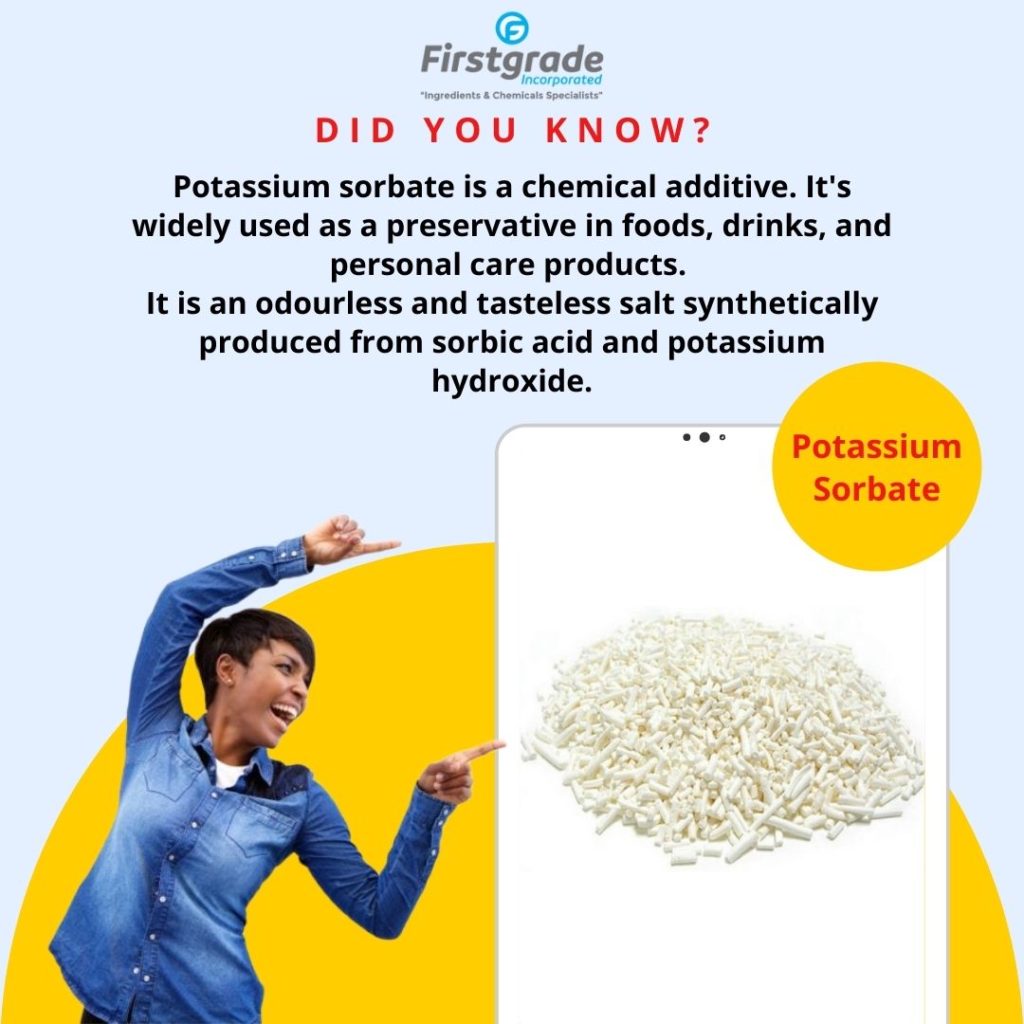
Benefits and Uses of Potassium Sorbate
Potassium sorbate is the potassium salt of a naturally occurring compound known as sorbic acid. Sorbic acid comes from the vibrant berries of the rowan tree (Sorbus aucuparia), a type of mountain ash known for its hardiness in cold weather.
Potassium sorbate has been valued for decades for its antimicrobial properties and is an especially effective food preservative found in dehydrated meats, dairy products, wine, and pastries. Potassium sorbate can prevent the growth of fungi, mould, yeast, and other potentially harmful foodborne pathogens.
This natural preservative isn’t as effective against bacteria and will need to be complemented with other preservatives, such as rosemary or sodium benzoate.
While potassium sorbate can be naturally sourced, the most common way of producing potassium sorbate is through synthetic methods; specifically, by neutralizing sorbic acid with hydrogen peroxide. The result is a compound identical to that found in nature.
Potassium sorbate makes an effective preservative in food, but this ingredient’s antimicrobial and antifungal properties are easily transferred to cosmetic products. Since this preservative is a viable alternative to more harmful parabens, it’s become quite popular in clean skincare and natural makeup.
As a result, potassium sorbate is often used in products at a concentration of up to 1% as a preservative. However in recent years, the word “preservative” has developed a strange stigma as something that’s dangerous or harmful to our health – but this assumption needs to be unpacked to be fully understood.
In recent years, you might have noticed an increase in products – both food and makeup – with labels proclaiming they’re “preservative-free”. Or perhaps you’ll see claims that they’re free of parabens, preservatives and dyes. In the same vein, you may have been led at some point to believe that preservatives aren’t necessary, or even harmful.
While there are absolutely harmful preservatives worth avoiding, these glittering generalities are a bit misleading, as they imply that preservatives are inherently bad. The truth is that preservatives are not bad; in fact, they are actually quite important, as they keep your beauty products from spoiling.
Preservatives are used in skincare products to keep us safe. Specifically, they help prevent the onset of harmful pathogens like mould, bacteria, and fungi. This system is crucial in products that contain water: the key conduit of bacteria, especially when combined with oxygen.
The bottom line is that without preservatives, your beauty products will quickly spoil. However, some companies have led consumers to mistrust preservatives in skincare, even potentially harmless ones like potassium sorbate.
The truth is that as a group of ingredients, preservatives are not inherently bad and actually serve an important role. Yet there are certain ones that are best avoided: these include parabens and formaldehyde-releasing preservatives like bronopol, glyoxal, and DMDM. In summary, learn to read a list of ingredients and be sure to keep away from toxic preservatives.
So what exactly do the experts say about potassium sorbate’s ingredient safety?
According to evaluations by Cosmetic Ingredient Review (CIR), potassium sorbate has been deemed as a safe ingredient in personal hygiene and cosmetic products. They use trials in which subjects used potassium sorbate at levels of 10%, which is far higher than the concentrations used in cosmetics. It was found that even at this level, potassium sorbate caused no irritation to the eyes, and was only mildly irritating to the skin. Further studies have also affirmed that potassium sorbate is a safe preservative.
According to the Environmental Working Group (EWG), potassium sorbate ranks as a 3 on a scale from 1 to 10 with, 1 being the lowest health risk and 10 being the highest. While some individuals are allergic to potassium sorbate, this occurrence is quite rare.
The FDA reviewed potassium sorbate as a preservative ingredient and has also determined that it’s Generally Recognized As Safe (GRAS) as a preservative for direct addition to food.
If you’re still curious about preservatives and cosmetic ingredients, keep up with our blog!